Garage Door Safety Sensors Explained
The safety sensors are the small boxes near the floor on either side of the garage door, and they are the reason a garage door cannot close on a person, a pet, or a car. This guide explains what they do, what their lights mean, and how to fix the most common problems — most of which take two minutes and no parts.
Hours: Mon–Fri 7:00 AM–10:00 PM ET · Sat 8:00 AM–10:00 PM ET · Sun 7:00 AM–9:00 PM ET
Call now for garage door repair
Describe the door and the symptoms, and the visit will confirm what the door needs before any work starts.
Call NowServing Worcester and Worcester County, Massachusetts.
In short
Garage door safety sensors are photoelectric eyes: one sends an invisible beam across the doorway and the other receives it, and if the beam is broken the opener will not close the door. They have been required on residential openers since 1993. A steady light means aligned and working; a blinking light means misalignment; a dark light means no power.
What the sensors do, and why they matter
The sensors are a simple idea with a serious job. A beam of invisible light runs across the doorway, a few inches above the floor, from a sending sensor on one side to a receiving sensor on the other. If anything breaks the beam — a person, a pet, a bike, a box — the opener will not close the door, or it will reverse a door that is already closing. The sensors are tested by the opener every time the door closes, and they are the reason a garage door cannot close on a child or a car. They work together with the safety reverse — the system that makes the door reverse when it meets an obstruction — and both must work for the door to be safe. The sensors are wired to the opener, and the opener will not run a closing cycle if it cannot see both sensors working.
What the lights mean
Each sensor has an indicator light, and the light is the diagnostic. A steady light means the sensor is aligned and working. A blinking light usually means misalignment — the sensor has been knocked and no longer points at its partner. A dark light usually means the sensor has no power, which points at the wiring: a wire nicked by a staple, chewed by a mouse, or pulled loose at a connection. If one sensor shows a steady light and the other blinks, the blinking one is the problem; if both are dark, the power to the sensors is the problem. The lights are the first thing to look at when a door will not close, because they tell you whether the sensors are working before you touch anything else.
The common problems, and the two-minute fixes
Most sensor problems are simple. A sensor knocked out of alignment — by a foot, a broom, a stored box, or a car bumper — no longer points at its partner, and the fix is to loosen the bracket, aim the sensor, and tighten it so it stays put. A dirty lens — dust, cobwebs, road salt film — weakens the beam, and the fix is wiping both lenses with a soft cloth. A blocked beam — a box, a bike, a bag of salt, a spider web across the doorway — breaks the beam, and the fix is moving the obstruction. And low winter sun shining directly into the receiving sensor can overwhelm the beam, so the opener refuses to close the door on sunny winter afternoons; the fix is a small shade over the receiving sensor, not a new opener. If the lights are steady, the lenses are clean, the beam is clear, and the door still will not close, the problem is in the wiring or the opener's circuit board, and the visit starts there.
Testing the sensors properly
A sensor repair is not complete until it is tested. The door should close fully, and breaking the beam with a hand or a box while the door is closing should make it reverse immediately. The test should be done after any sensor work — realignment, cleaning, rewiring or replacement — because a sensor that looks aligned is not necessarily aligned, and a beam that looks clear is not necessarily unbroken. The safety reverse should be tested at the same time: place an object in the door's path and confirm the door reverses on contact. The two systems protect the household together, and both must work before the visit ends. And the force setting should be checked too: a household that has been holding the wall button down to force the door closed may have masked a limit problem, and the force should be set to the minimum that moves the door reliably.
Sensors on older openers: the 1993 line
The year 1993 divides garage door openers into two kinds, and the sensors are the reason. Before 1993, residential openers were not required to have photoelectric safety sensors, and many of them have only a mechanical reverse — a system that stops the door when it meets enough resistance. A mechanical reverse is better than nothing, but it is not the same as a sensor: it reacts to contact, while a sensor prevents contact. An opener made before 1993 cannot be made safe by adding sensors, because the opener's circuit board was not designed for them, and the honest answer for a pre-1993 opener is a replacement with a modern unit. An opener made after 1993 has the sensors, but the sensors themselves age: the lenses cloud, the wiring frays, the electronics weaken, and the lights that were steady for a decade start to blink. The check is the same on any age of opener — steady lights, clean lenses, clear beam — but the meaning differs: on a modern opener, a blinking sensor is a repair; on a pre-1993 opener, the absence of sensors is a replacement. The household should know which side of the line its opener sits on, because the answer follows from it.
Related services and guides
Garage Door Sensor Repair
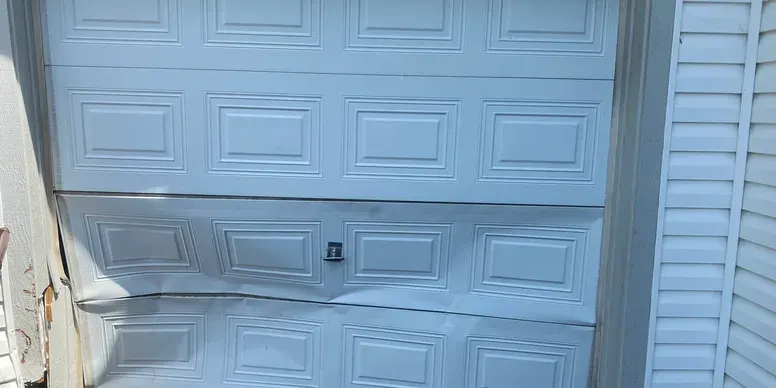
Garage door sensor repair in Worcester, MA for safety sensors that stop the door from closing. Alignment, wiring and ope
Garage Door Opener Repair
Garage door opener repair in Worcester, MA for openers that hum, click, reverse, or stop responding. Diagnosis at the mo
Garage Door Closes Then Opens
Garage door closes then opens again in Worcester, MA? The cause is usually a sensor, a travel limit, or a door binding i
Garage Door Won't Open
Garage door won't open in Worcester, MA? Learn the checks that separate a door problem from an opener problem, and what
Emergency Garage Door Repair
Emergency garage door repair in Worcester, MA for doors that will not open, will not close, or are stuck open. Call now
Frequently asked questions
They are the photoelectric eyes mounted near the floor on either side of the door. One sends an invisible beam and the other receives it, and if the beam is broken the opener will not close the door. They have been required on residential openers since 1993.
A steady light means the sensor is aligned and working. A blinking light usually means misalignment, and a dark light usually means the sensor has no power — a wiring problem or a failed sensor unit.
The safety sensors are the most common cause. Check that both sensors show a steady light, that the lenses are clean, and that nothing is blocking the beam between them.
Yes. Low winter sun shining directly into the receiving sensor can overwhelm the beam, and the opener will refuse to close the door. A small shade over the receiving sensor usually fixes it.
Call now for garage door repair in Worcester, MA
Describe the door and the symptoms, and the visit will confirm what the door needs before any work starts.
Call NowContact
Call to describe the door and the symptoms, and the visit will confirm what the door needs before any work starts. Hours: Monday to Friday 7:00 AM to 10:00 PM ET, Saturday 8:00 AM to 10:00 PM ET, Sunday 7:00 AM to 9:00 PM ET.
hello@worcestergaragedoorpros.com · Serving Worcester and Worcester County, Massachusetts.
Call Now