How To Tell If a Garage Door Spring Is Broken
A broken garage door spring is easy to confirm once you know what to look for — a gap in the coils, a loud bang, a door that suddenly feels much heavier. This guide walks through the visual checks, the movement tests, and the signs that come before the break, so the household can catch a failing spring while it is still a planned repair.
Hours: Mon–Fri 7:00 AM–10:00 PM ET · Sat 8:00 AM–10:00 PM ET · Sun 7:00 AM–9:00 PM ET
Call now for garage door repair
Describe the door and the symptoms, and the visit will confirm what the door needs before any work starts.
Call NowServing Worcester and Worcester County, Massachusetts.
In short
A broken torsion spring shows a clear gap in its coils above the door; a broken extension spring hangs loose along the track. The other signs are a loud bang from the garage, a door that will not lift or lifts a few inches and stops, and a door that suddenly feels much heavier by hand.
The visual check: look at the spring
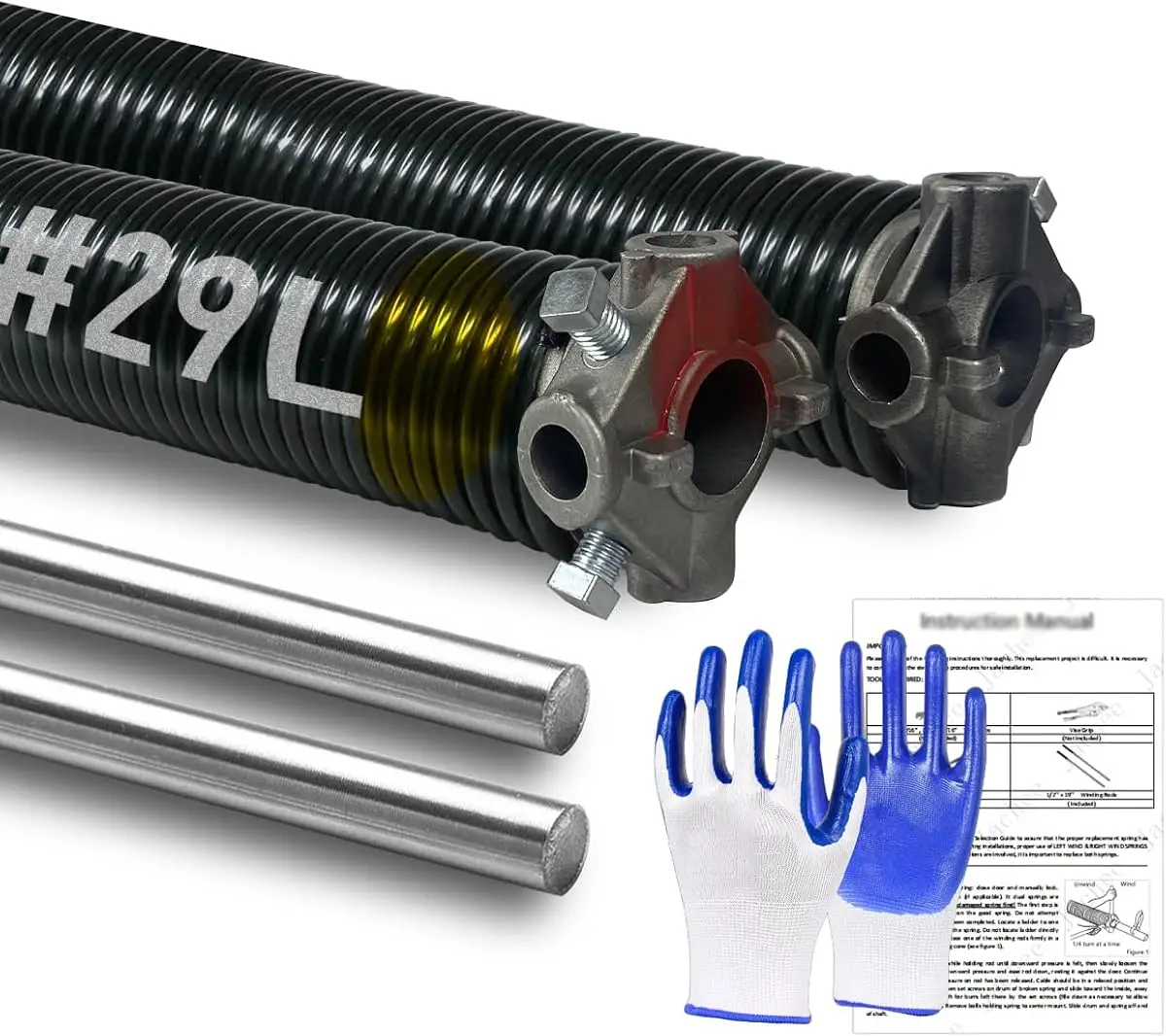
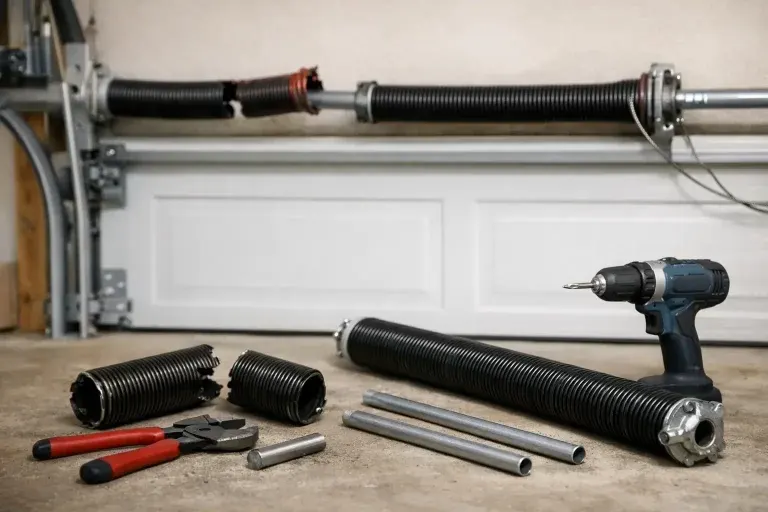
Stand inside the garage and look at the spring. On a torsion-spring door, the spring is the heavy coil mounted on a shaft directly above the door opening. A broken torsion spring shows a clear gap in its coils — usually about two inches wide — where the steel separated. The gap is unmistakable once you have seen it: the coil is in two pieces with daylight between them. On an extension-spring door, look along the horizontal tracks on either side: a broken extension spring hangs loose, is stretched out of shape, or has a visible gap in its coils. Also look for rust along the coils, especially at the ends where the spring meets the cone, and for a safety cable that is missing or frayed on an extension-spring door — the cable is the part that contains the spring if it snaps, and many older doors are missing it.
The movement test: lift the door by hand
Disconnect the opener by pulling the emergency release cord, then lift the door by hand. A door with sound springs lifts with moderate effort, holds steady at waist height when released, and lowers smoothly without slamming. A door with a broken spring will not lift, or lifts a few inches and stops, or feels far heavier than it used to. A door that drifts down when it should hold steady has lost spring tension; a door that drifts up is over-sprung. The movement test is decisive, but it has a safety rule: if the spring is broken, do not try to lift the door past a few inches — the door's full weight is on the person lifting it, and it can drop once it starts moving. Lift a little, feel the weight, and stop. The weight alone is the answer.
The signs that come before the break
Springs rarely break without warning, and the warning signs are easy to spot. The first is weight: a door that feels heavier than it used to, or a door that the opener strains to lift, has lost spring tension. The second is sound: a spring that groans, squeaks or pops through its travel is telling the household that the coils are dry, rusted or fatigued. The third is balance: a door that drifts down when it should hold steady, or a door that opens unevenly — one side ahead of the other — has a spring failing on one side. The fourth is visual: rust along the coils, a spring that looks stretched or uneven, or a cable that is fraying at the drum. The habit that catches all of this is a twice-yearly look: stand inside the garage, look at the springs and cables, lift the door by hand, and listen. Five minutes, twice a year, is the difference between a planned replacement and an emergency call.
What a broken spring is not
A broken spring is sometimes confused with a broken opener, because the symptom is the same: the door does not move. The difference is the hand test — if the door is heavy by hand, the spring is the problem; if the door lifts easily by hand, the opener is the problem. A broken spring is also confused with a snapped cable, and the two often arrive together: a spring that snaps puts extra load on the cables, and a cable that snaps leaves the door crooked. The visual check separates them: a gap in the spring coils means the spring, a cable hanging loose beside the track means the cable. And a broken spring is not a door that is stuck: a stuck door is jammed in its tracks, while a door with a broken spring is un-counterbalanced — it is not stuck, it is too heavy to move, and forcing it will bend the tracks or strip the opener's gear.
Torsion vs extension: the check differs
The check for a broken spring differs by the system, and knowing which system the door has is the first step. On a torsion-spring door, look at the coil mounted on the shaft above the door: a broken spring shows a clear gap in its coils, usually about two inches wide, where the steel separated. The gap is unmistakable once you have seen it. On an extension-spring door, look along the horizontal tracks on either side: a broken extension spring hangs loose, is stretched out of shape, or has a visible gap in its coils — and the safety cable through its centre, if it is present, will be holding the broken pieces. The movement test is the same for both: disconnect the opener and lift the door by hand. A door with a broken spring will not lift, or lifts a few inches and stops, or feels far heavier than it used to. But the safety rule differs: a broken torsion spring stays on its shaft, while a broken extension spring without a safety cable can fly across the garage — which is why the cable check matters, and why a household with an extension-spring door should look for the cable before anything else. Either way, the diagnosis is confirmed by the visual check and the weight, not by running the opener again.
Related services and guides
Broken Garage Door Spring Repair
Broken garage door spring repair in Worcester, MA. Learn the signs of a snapped torsion or extension spring, why the doo

Garage Door Spring Replacement
Garage door spring replacement in Worcester, MA for torsion and extension springs. Matched springs, rebalancing, and ful
How Long Do Garage Door Springs Last?
How long do garage door springs last in Worcester, MA? Cycle ratings, what shortens a spring's life, and the signs yours
Garage Door Spring Broke — What To Do
Garage door spring broke in Worcester, MA? What to do right now, what not to do, and how the repair visit works — spring
Garage Door Won't Open
Garage door won't open in Worcester, MA? Learn the checks that separate a door problem from an opener problem, and what
Frequently asked questions
Look at the torsion spring above the door: a broken one shows a clear gap in its coils. On an extension-spring door, look for a spring hanging loose along the track. The other signs are a loud bang and a door that will not lift or feels much heavier.
A torsion spring with a gap of about two inches in its coils, where the steel separated. An extension spring hanging loose or stretched out of shape along the track. Rust along the coils is the sign that comes before the break.
You should not try past a few inches. Without the spring, the door weighs its full weight and can drop once it starts moving. Lift a little to feel the weight, then stop — the weight alone confirms the diagnosis.
Usually, but not always. A torsion spring snapping sounds like a firecracker inside the garage. A spring that fails quietly still shows the same signs: a gap in the coils, a heavy door, and an opener that hums without moving the door.
Call now for garage door repair in Worcester, MA
Describe the door and the symptoms, and the visit will confirm what the door needs before any work starts.
Call NowContact
Call to describe the door and the symptoms, and the visit will confirm what the door needs before any work starts. Hours: Monday to Friday 7:00 AM to 10:00 PM ET, Saturday 8:00 AM to 10:00 PM ET, Sunday 7:00 AM to 9:00 PM ET.
hello@worcestergaragedoorpros.com · Serving Worcester and Worcester County, Massachusetts.
Call Now